
Sharpening Your Knife Blade
Knife Care Article
Crazy Crow Trading Post ~ Updated October 6, 2026
Sharpening Your Knife Blade
Knife Care Article
Crazy Crow Trading Post ~ Updated October 6, 2026
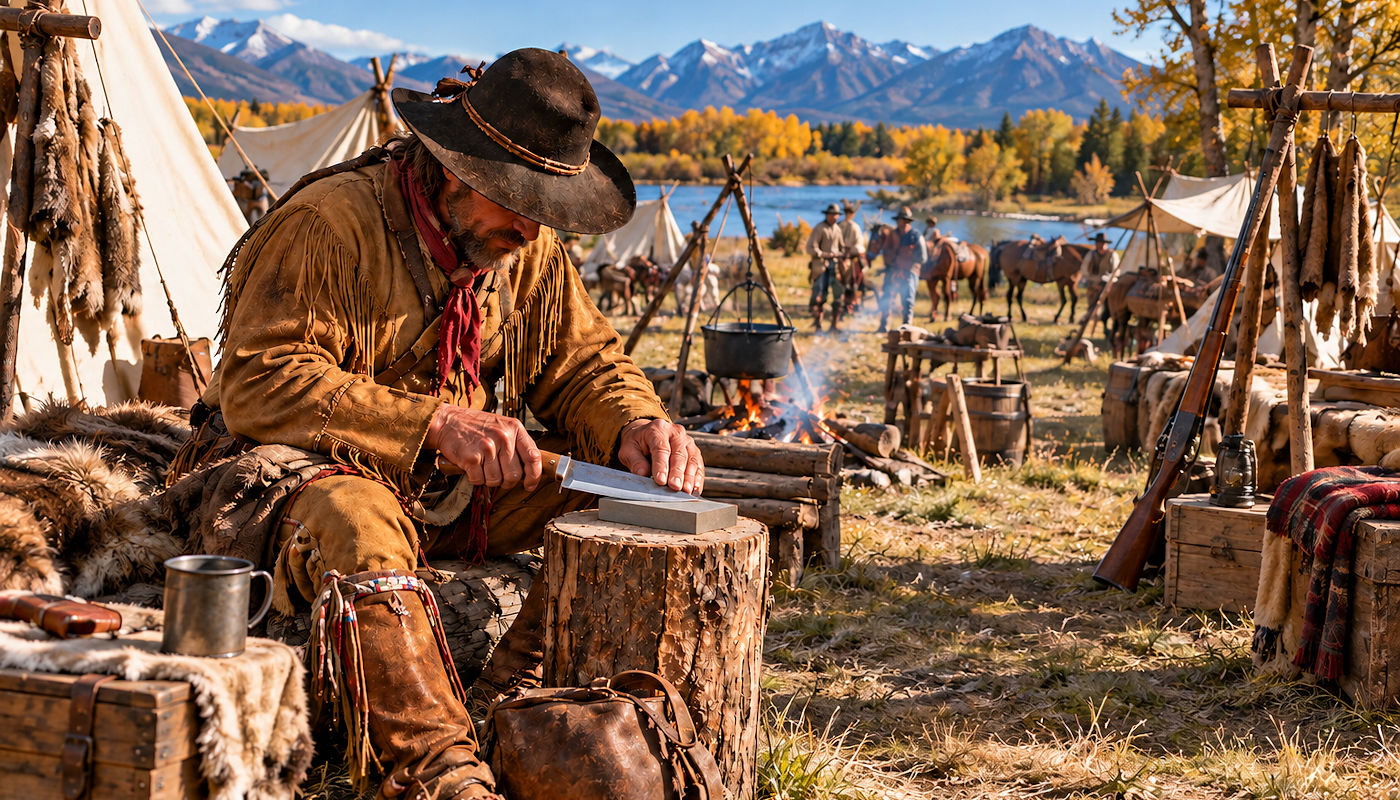
The most difficult knife care task is said to be sharpening a blade. Crazy Crow Trading Post primarily carries Carbon Steel knife blades, which are authentic for the Colonial and Fur Trade Period and are easier to sharpen than modern stainless steel. Carbon Steel is more prone to rusting, but when properly sharpened, will hold a good edge for a long time and is also easier to resharpen when necessary.
When sharpening your knife, we recommend using high-quality sharpening stones of either the diamond abrasive type, natural oil stones, or water stones.

Diamond Sharpening Stones: These sharpening stones are graded numerically, and a coarse grit stone is used first for the initial shaping of the edge, followed by successively finer grits to create a razor edge. For example, you can start with a coarse grit of 260, then switch to medium grit of 400, then to a fine grit of 600, and finally for a super sharp edge, use a 1200 grit stone. These stones should be lubricated, and water with a little soap added is used, or a product like Windex also works well.
Waterstones Roughly equivalent to diamond stones in the way that they are graded, they normally run from 150 grit up to as high as 8,000 grit for a super high polished edge on things like wood carving tools. These stones must be soaked in water before use and are a bit messier to use than oil stones or diamond stones, but they cut faster and can produce a very fine edge. Water is the lubricant for these stones.
Oil Stones: These stones come in natural or synthetic varieties. Synthetics are graded similarly to diamond stones, in various grit sizes. Natural stones, known as Arkansas stones, are quarried and are graded by stone density, such as soft, hard, black and translucent. These stones are lubricated with a light oil, such as mineral oil, or light machine oil can also be used.
Ceramic Stones: This sharpening stone is normally used to obtain a final polish for a super sharp edge using water as lubricant.
Sharpening Your Knife Blade: Step-by-Step
Native American Online Resources

Current Crow Calls Sale
September – October 2026
SAVE 10%-20% on popular powwow, rendezvous, historic reenactor, bead & leather crafter supplies. on Green River Knives, Custom Throwing Hawk (our most popular) & other styles, select handmade frontier knives & a wide range of camping supplies (cookware, utensils, firetools, kettles, boilers, cups, etc.). Other sale items include authentic reproduction Gorgets, Nickel & Brass Plated Bells, Sweetgrass Braids, Smudge Sticks, Genuine Buffalo Skulls & Horns, Southwest Style Totes, big savings on #2 German Tan Buckskin, and much more!
Sharpening Your Knife – Related Products (click images to view product detail)
The following items are used in the above-article, or may provide added reference and helpful information.

Pocket Sharpener with Pen Holder
Diamond sharpeners cut fast, producing a keen edge quickly and last almost indefinitely. These sharpeners will give you uninterrupted sharpening in any direction. Diamond sharpeners are not messy like oil stones and are great in the field. Use them on your hunting knife, fish hooks, homeware, or tools. Product No. 4920-230-022

8″ Sharpening Stone
Sharpening stones, like Crazy Crow’s 8″ Sharpening Stone, are the most traditional way to sharpen knives and tools. They are versatile and can be used to sharpen almost any edge. Our Sharpening Stone is made from an Aluminum Oxide construction and measure 8″ x 2″ x 1″. Each stone has both a coarse and medium grit side. Product No. 4920-010-008